
The Ache and Wonder of Living With Machines
Being human inside systems that cannot see us whole—and the hope of building ones that can

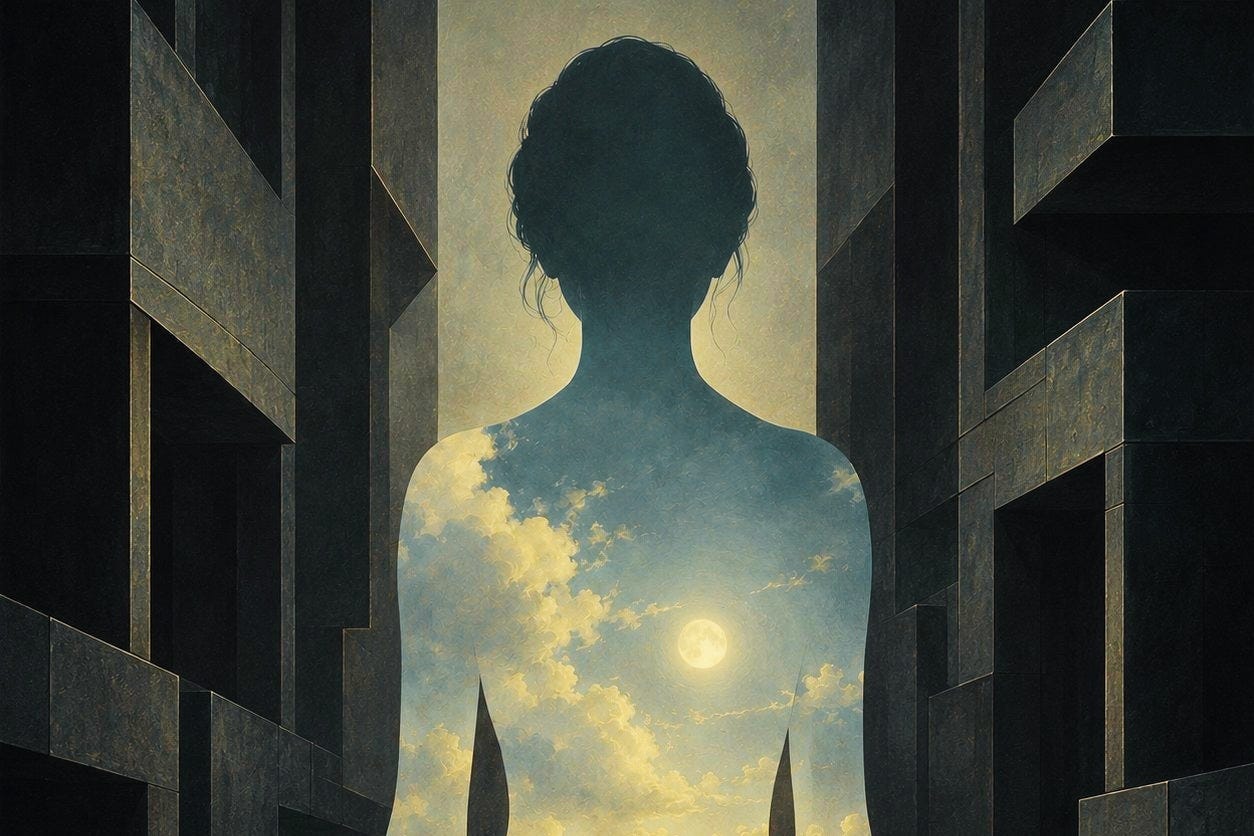
You’ve felt it, even if you didn’t have a name for it.
The medical system that scans your body in extraordinary detail but dismisses you when you say something is wrong. The insurance company that denies the treatment your doctor says you cannot live without. The workplace that measures every aspect of your productivity except how much it is wearing you down. The form with a box for every situation except the one you’re in.
Each time, something goes unseen. Not your data—your reality. The system builds a version of you out of what it can measure, then treats it as the whole person. Everything else falls outside the frame.
This is the ache of living with machines. The mortal pressed against a world that cannot see what it is like to be human—fragile, dependent, and yearning. The machine is the world we engineered to serve human life: the technologies, processes, and institutions that know us by our data but miss the person. This is not an argument against technology or AI. It is a call to build systems that can see human reality—and make room for it.
I came to this understanding through an unusual path. I began as a dancer—learning the language of the body before I spoke the machine’s. Then I became an engineer and learned to build the systems that shape our lives. Moving between the worlds of flesh and code taught me to see—and give language to—the friction where the two meet: the gap between human reality and what the machine can hold. That friction turned deadly when the medical system missed my cancer because it dismissed my lived experience.
Technology has lifted human life in ways we could not have dreamed—curing diseases that once killed us, carrying our voices across the world, and placing vast stores of human knowledge in our hands—but it has also quietly reduced us in ways we have not yet named. We feel it every time we shrink ourselves to fit—contorting ourselves around machine rules that were never designed for a human being. We learn to leave out the part that aches, the part that objects, the part that does not fit. And slowly, without deciding to, we start to disappear from our own lives.
None of this was written in stone. The parts of us the machine cannot see are not the parts we should lose. They are the parts that reveal the current limits of the machine’s vision—the ache it cannot read, the objection it cannot hear, the human reality it cannot recognize.
The next generation of machines can be built to see us whole. The opportunity before us is not to make human beings fit the machine, but to build machines that make room for being human. That is the wonder still ahead of us: machines that expand human possibility and leave us feeling safer, stronger, and larger. It can be done.
What stayed with me Sylvie, is that this isn't really an essay about technology. It's an essay about reduction.
Your phrase, "The system builds a version of you... and then treats that version as the whole of you," captures something many people have experienced without ever quite finding the language for it. That's what I think the essay does so well: it gives a name to a quiet form of modern suffering.
I also appreciated that you resist the easy temptation to make this an argument against technology itself. Instead, you ask a much more interesting question: not whether machines should exist, but whether the systems we build can become spacious enough to accommodate the irreducible complexity of being human. That shift elevates the essay from critique to vision.
And perhaps my favourite line is the last: "The work is not to shrink the human being to fit the machine, but to widen the machine to fit the human being." It feels less like a conclusion than a design principle—one that extends far beyond AI into education, healthcare, work, and almost every institution we inhabit.
I'm happily subscribing because I enjoy essays that don't simply identify a problem but give us a new lens through which to see it. I also write at The Reflective State, where I often explore the hidden assumptions beneath our institutions and everyday lives. If curiosity ever leads you there, I think The Implicit Behind the Explicit might make for an interesting companion piece, and I'd genuinely love to hear your thoughts on it.
“The new claustrophobia” gives a name to something I have felt in today’s world and never had words for. Thank you for giving language to this experience.